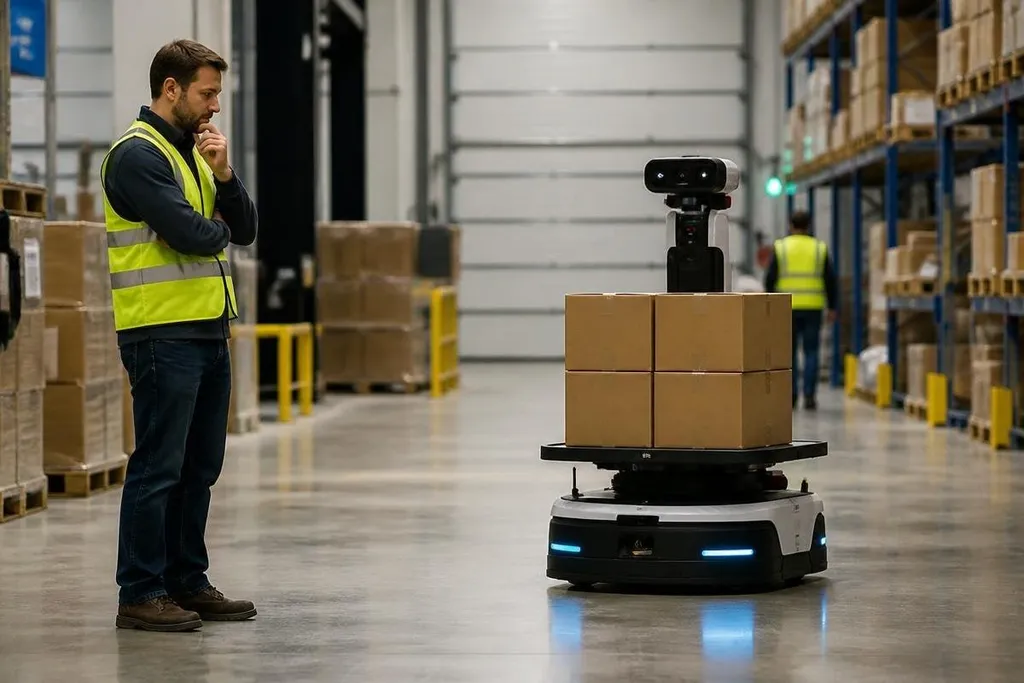
An autonomous robot may choose a route, slow down, stop, or change its task without a person pressing a button. The hard question is where that freedom should end when the robot faces an unsafe or unclear situation.
Quick read
- Autonomy works best when the robot has a narrow job and clear limits.
- A human should take over when the robot cannot read the scene with enough confidence.
- Logs, stop controls, and set approval rules matter as much as the robot’s sensors.
What a robot is deciding
A robot does not make choices in the human sense. Its software reads sensor data, compares that data with set rules or a trained model, then selects an action from the options it has been given.
A warehouse robot may see a blocked aisle and pick another route. A mobile inspection robot may stop when its camera cannot identify a valve. A robotic arm may pause when a person enters its work area. Each action comes from a defined task, a set of inputs, and a limit on what the system can do.
That limit matters because sensor data is never the same as the scene itself. A camera can miss a thin cable. LiDAR can return unclear readings around glass or dust. A model can assign the wrong label to an object it has rarely seen. When the input is weak, a confident action can create a physical hazard.
The case for more autonomy
People cannot approve every small movement in a busy facility. A robot that needs permission to avoid every empty box will stop too often to do useful work. Giving it room to choose a safe route or adjust its speed can reduce delays and keep staff from watching routine movement all day.
The strongest case is narrow autonomy. The robot gets a task, a permitted area, a speed limit, and rules for stopping. It can make quick choices inside that box while a person handles events outside it.
This approach also gives engineers a clearer test. They can check how the robot acts when an aisle is blocked, a sensor fails, a person crosses its path, or the assigned load is missing. A wide claim about intelligence is hard to measure. A list of allowed actions is easier to inspect.
A robot can follow a narrow rule and still make a bad choice when a case falls outside it. A report at Robot24 can tie the word “autonomous” to the robot’s task, stop rules, and human handoff. That gives the debate a test you can inspect before the next question: where should a person take control?
Where human control belongs
Human approval should enter when the cost of a wrong choice is high, the scene falls outside tested conditions, or the robot’s confidence drops below a set level.
The person does not need to guide every motor command. They need a clear way to stop the task, review what happened, and approve the next action.
That requires more than an emergency stop. A workable system should record the sensor view, the chosen action, the reason for the choice, and the point where control passed to a person. Without those records, an incident becomes a dispute about what the robot may have seen.
Responsibility also needs a named owner. The robot maker may control the software. A site operator may set the work area and speed. A supervisor may approve a task. Those roles should be written down before the robot starts work, rather than sorted out after an injury or damaged part.
I’d keep high-risk decisions with a person until the robot has shown safe behavior across the exact places, objects, and failure cases it will face.
A practical decision guide
Use these checks before giving an autonomous robot more freedom:
- Define the task. Write the actions the robot may take and the actions that require approval.
- Set stop rules. Include poor sensor readings, blocked routes, lost communication, and people entering the work area.
- Set a handoff point. Decide who receives control and how fast they must respond.
- Keep the record. Store the sensor data, software decision, warning, and human action for each unusual event.
- Test the edges. Use damaged labels, poor lighting, loose objects, network loss, and unfamiliar layouts.
- Review changes. Recheck the rules after a software update, new tool, new load, or change to the work area.
These checks turn a broad argument about robot freedom into a work question: which choices can the robot make safely, and which choices still need a person?
The decision ahead
Autonomous control will fit routine tasks sooner than open-ended work. The useful measure is not how often a robot acts without help, but whether it knows when to stop and gives a person enough information to take over.
That standard leaves room for faster machines without treating uncertainty as permission to guess. Before a robot receives a wider task, its operator should be able to name the stop rules, the human owner, and the evidence that the robot can handle the job.